Nyansapo Fellowship
The Nyansapo Fellowship is an initiative to educate and empower young Ghanaians about the nation’s founding principles of liberty and free markets to ensure a sustainable democratic future.
EXECUTIVE SUMMARY
The Nyansapo Fellowship addresses a critical structural gap in Ghana's policy landscape: the absence of a practical pipeline linking university talent to free-market policy analysis and strategic regulatory advocacy.
By equipping university students with technical policy-evaluation tools, legal reasoning, media framing, and market-based economic principles, the initiative transforms high-potential students into active policy advocates who can drive regulatory reform in Ghana.

OUR PURPOSE
About the Nyansapo Fellowship
The Nyansapo Fellowship is a strategic initiative designed to revitalize and propagate Ghana’s rich cultural legacy of “freedom and justice,” a cornerstone of the nation’s identity since its independence in 1957. The programme takes its name from Nyansapo, the “knot of wisdom”.
Ghana, a trailblazer in sub-Saharan Africa’s independence movement, has a storied history of championing liberty and economic freedom. However, these ideals have been largely absent from political discourse over time, leading to a knowledge gap among the younger generation regarding the country’s founding principles. The Nyansapo Fellowship aims to address this lacuna by educating and empowering young people to become advocates for liberty, individual rights, and free markets, thereby ensuring the sustainability of Ghana’s democratic heritage.
Objective
To create a dynamic platform for students to engage with libertarian ideas, explore their practical applications in Ghana, and cultivate a new generation of leaders who will champion individual liberty, limited government, and free markets.
CORE STRATEGIC PILLARS
Nyansapo Fellowship
1. Capacity Building
- Policy Brief Writing
- Cost-Benefit Analysis
- Market Economics
2. Advocacy Pipeline
- Media & Op-Ed Pitching
- Public Speaking & Debates
- Stakeholder Engagement
3. Regulatory Reform
- SME Tax Reform
- Business Un-red Taping
- Tech & EdTech Policy
TECHNICAL MASTERY
Capacity Building (Technical Mastery)
Objective: Move students from theoretical knowledge to actionable policy research.
Key Interventions
- Policy Analysis Methodology: Training in structural problem definition, empirical data gathering, and drafting concise 2-page policy briefs.
- Market-Oriented Frameworks: Applying cost-benefit analysis and evaluating the unseen consequences of price controls, trade barriers, and over-regulation.
- Financial & Legal Literacy: Reading tax regimes, analyzing statutory fees affecting SMEs, and understanding statutory interpretation for public interest advocacy.
PUBLIC & MEDIA ENGAGEMENT
Advocacy Pipeline (Public & Media Engagement)
Objective: Convert policy research into public commentary and strategic legislative engagement.
Key Interventions
- Media Framing & Storytelling: Training fellows to translate complex statutory legal language into engaging broadcast pitches, op-eds, and digital campaigns.
- Policy Pitching: Formalizing a pitch competition where student teams present reform proposals to policy experts, media personalities, and market practitioners.
- Coalition Building: Connecting fellows with think tank researchers, journalists, and business leaders to build long-term advocacy networks.
POLICY IMPACT
Target Reform Outcomes
Objective: Produce real-world policy deliverables aimed at simplifying Ghana’s regulatory environment.
Target Focus Areas
SME & Business Licensing
Formulating proposals to reduce red tape, statutory fees, and compliance friction for micro-enterprises.
Taxation & Compliance
Developing data-driven cases for tax simplification and predictable fiscal policy.
Sustainable Energy Bottlenecks
Reforming restrictive power purchase frameworks, grid-connection delays, and tariff structures that hinder private clean energy development.
Employment & Business Entry Friction
Simplifying high statutory registration fees, multi-agency permits, and labor market rigidities that disincentivize formal hiring.
Technology & Education
Advocating for streamlined regulatory frameworks for EdTech adoption and digital enterprise.
HOW THE PROGRAMME OPERATES
Implementation Roadmap
The programme follows four phases. Dates for the 2026 cohort are recorded separately below.
01
Recruitment & Selection
Recruitment and selection of university students.
02
Virtual Preparatory Sessions
Virtual preparatory sessions in policy and economic analysis.
03
Liberty & Policy Bootcamp
In-person learning, workshops and policy pitching.
04
Post-Bootcamp Advocacy & Publication
Mentorship, advocacy and publication of fellows’ work.
COHORT RECORD
2026 Cohort Roadmap
The following dates and activities relate to the 2026 cohort; they are not an announcement of a new application window.
01
March – Mid-August 2026
Phase 1: Recruitment & Selection
- Open applications across major Ghanaian university campuses (UG, KNUST, UEW, UCC).
- Screen and select top university students demonstrating interest in economics, law, policy, and entrepreneurship.
02
September 24 & October 1, 2026
Phase 2: Virtual Preparatory Sessions
- Session 1 (Sept 24): SME Tax Strategy, Financial Scaling & Compliance with Dickson Assan.
- Session 2 (Oct 1): Structural Methodologies for Writing Actionable Policy Briefs with Conrad Kakraba.
03
October 3, 2026
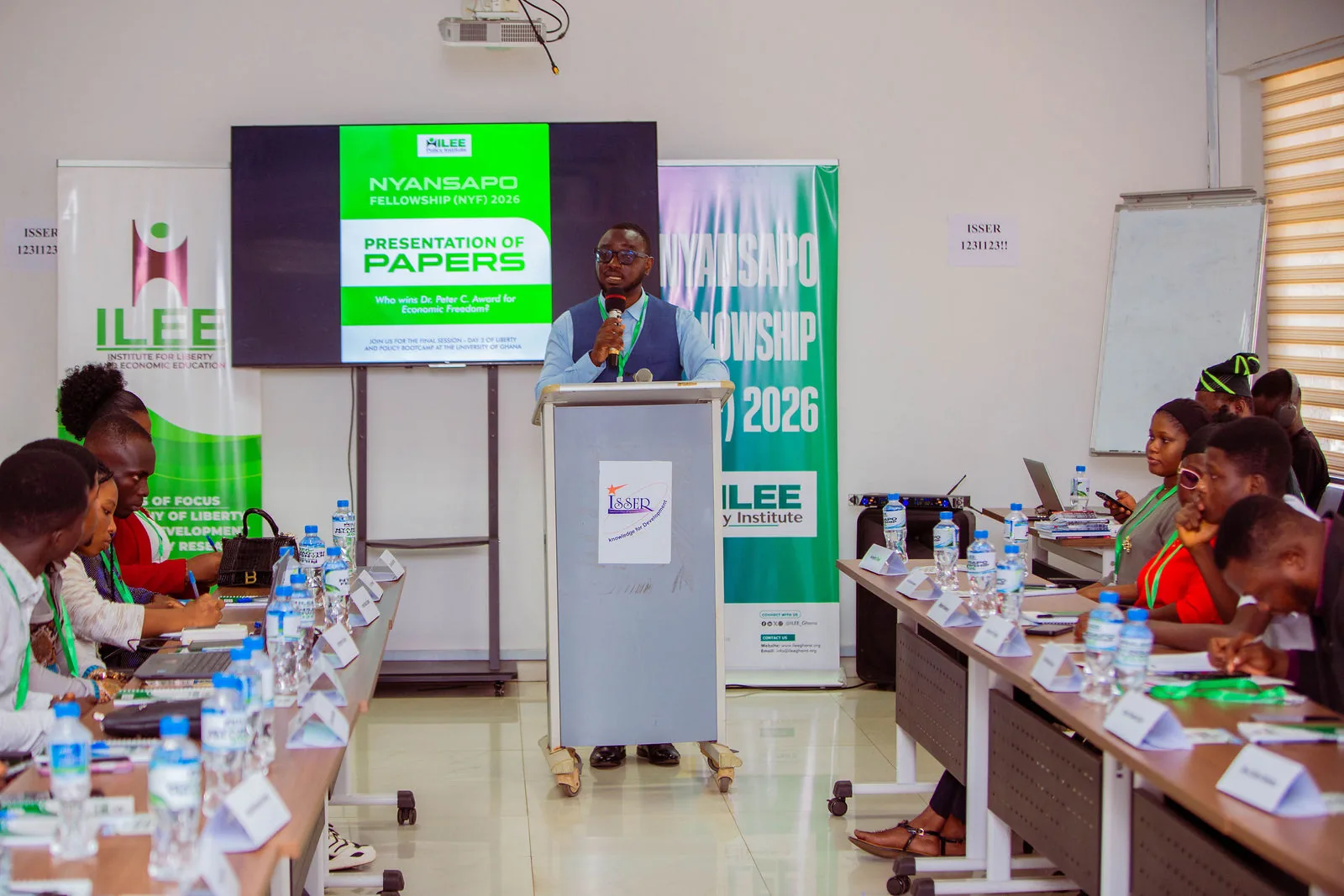
Phase 3: Liberty & Policy Bootcamp
- Full-day intensive in-person summit at the ISSER Auditorium, University of Ghana.
- Keynote address by Kofi Bentil on strategic law and free-market advocacy.
- Media framing lecture by Conrad Kakraba, breakout workshops, and student policy pitch competition.
04
October – December 2026
Phase 4: Post-Bootcamp Advocacy & Publication
- Mentorship pairings to finalize student policy briefs and op-eds.
- Submitting top-performing briefs to policymakers, media portals, and regional policy forums.
INTENDED OUTCOMES
Key Performance Indicators (KPIs)
These indicators are programme targets, not verified results or achievements.
Reach & Diversity
100+ University Fellows Trained
Ensure cross-campus representation from key public and private universities in Ghana.
Output
10+ Published Policy Memos / Op-eds
Generate tangible media and policy presence advocating for market reforms.
Skills Transfer
100% Policy Pitch Completion
Validate that every fellow can construct and defend a market-friendly reform pitch.
Network Growth
1 Policy & Media Network Established
Create an ongoing alum community for young market-oriented advocates in Ghana.
EXPLORE THE IDEAS
Markets, Knowledge, and Liberty
Explore the intellectual foundations of free-market thought.
GET INVOLVED
Programme enquiry
Contact ILEE to enquire about the Nyansapo Fellowship, future cohorts or partnership opportunities.