1. Executive Summary
The Institute for Liberty and Economic Education held the in-person Nyansapo Fellowship 2026 Liberty and Policy Bootcamp on Saturday, 3 October 2026, at the ISSER Auditorium, University of Ghana, Legon. The event combined fellows’ policy presentations with discussions on liberty, advocacy, law, financial literacy, entrepreneurship, education, and economic reform.
The recorded Fellows' participation included students from the University of Ghana, the University of Education, Winneba, the University of Cape Coast, Kwame Nkrumah University of Science and Technology, Kumasi, and the University of Development Studies, Tamale. Together, these represented 50 participants from across the south, east, west, and north of Ghana.
The program opened with introductions and remarks from Eric Coffie, Founding President of ILEE, followed by the fellows’ pitch competition. Subsequent sessions explored the philosophical foundations of liberty and the communication skills needed to make policy proposals persuasive.
Kofi Bentil delivered the keynote address on leveraging strategic law and free-market principles to drive national reform. As the program’s principal speaker, he examined fundamental rights, the social contract, and modern democracy. His address emphasized equality of opportunity, individual dignity, property rights, freedom of expression, and the importance of sustained effort in building a good society.
The afternoon proceedings addressed decentralized finance, business financial literacy, the practical relevance of education, and the relationship between macroeconomic stability and enterprise performance. The program concluded with competition results, a review of written policy briefs, certificate presentations, and the closing ceremony.
ILEE KNUST won the Dr. Peter C. Earle Award for the Economic Freedom pitch competition and received a cash prize of 500 US dollars. In the subsequent written policy brief assessment, ILEE UCC placed first, followed by UEW, KNUST, and UG.
2. Introduction
The Nyansapo Fellowship 2026 Liberty and Policy Bootcamp brought ILEE University Chapters together to examine ideas about freedom and apply them to practical policy questions. Its proceedings combined philosophical discussion with instruction on communication, economic decision-making, and reform.
The event let fellows present their policy work to judges and receive feedback on their written submissions. Speakers from law, philosophy, communications, finance, education, and economics offered different perspectives on the relationship between individual agency and the wider institutional environment.
This report presents the proceedings chronologically, with particular attention to Kofi Bentil’s keynote address and its contribution to the program’s central themes.
3. Registration, Introductions, and Opening Proceedings
The program began with registration and breakfast. The recorded ILEE University Chapter participations were ILEE UG, ILEE UEW, ILEE UCC, ILEE KNUST, and ILEE UDS.
Dr. Stephen Morgan introduced the program, after which participants introduced themselves. This established chapter representation and allowed participants to get acquainted.
Eric Coffie delivered the opening remarks. He briefly outlined the Dr. Peter C. Award for Economic Freedom, explaining its significance and purpose within the fellowship. His remarks set the day’s objectives and inspired fellows to engage fully.
Dr. Morgan subsequently introduced the judges for the fellows’ pitch competition: Dr. Nancy Myles, Solomon Okine, and Dr. Paul Appiah-Konadu.
Dr. Stephen Morgan and Miss Christabel Klay served as masters of ceremonies.
4. Session One — Fellows’ Pitch Competition
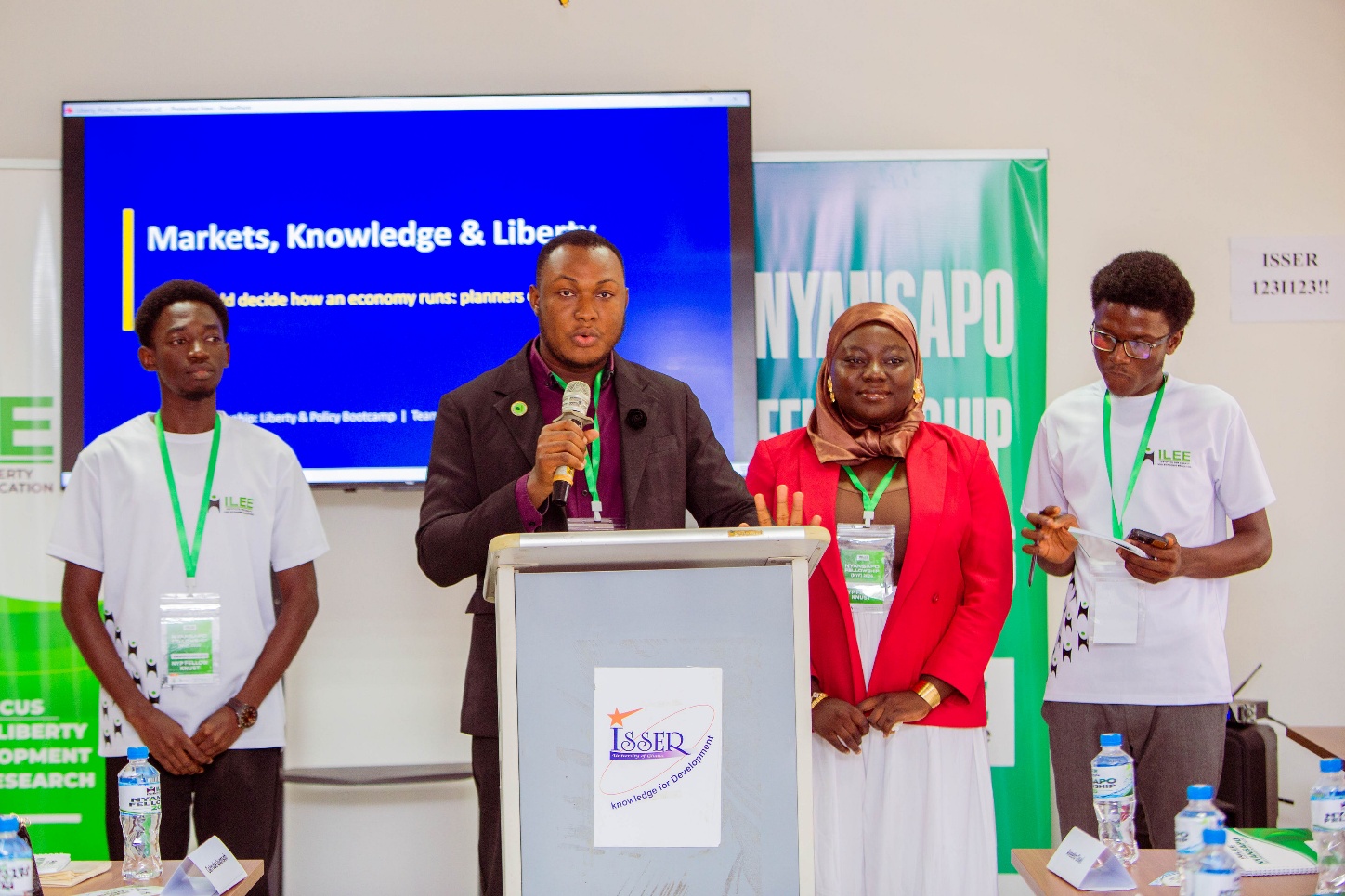
The first substantive session was the fellows’ pitch competition for the Dr. Peter C. Earle Award for Economic Freedom. Presentations followed this order: ILEE UG, ILEE UEW, ILEE UCC, ILEE KNUST, and ILEE UDS.
The competition presented the chapters’ policy proposals to the judging panel, adding a practical dimension to the program from the outset. Fellows presented their work to the judges, and the competition results were announced toward the end of the event.
5. Session Two — Understanding Libertarian Philosophy
Dr. Nancy Oppongwaa Myles
Dr. Nancy Myles presented on “The Case for Liberty: How Economic Freedom and Individual Sovereignty Shape Human Flourishing.”
She began by connecting Nyansapo to the difficulty of real problems. She explained that solving such problems requires the freedom to think, experiment, make mistakes, and try again. She paired this account with the principle that freedom must respect others.
Dr. Myles distinguished negative freedom, understood as the absence of obstruction, from positive freedom, understood as acting according to one’s own reasons and purposes. She drew on several philosophical perspectives to explain the relationship between liberty and legitimate authority.
Her discussion included John Locke’s account of government by consent, John Stuart Mill’s harm principle, Immanuel Kant’s insistence that persons should be treated as ends in themselves, and Robert Nozick’s argument that individual rights constrain what states and majorities may do.
She described individual sovereignty as rightful authority over one’s life, body, and labor, subject to equal respect for the sovereignty of others. She also connected liberty with human flourishing, drawing on Aristotle’s concept of eudaimonia.
The presentation considered decentralization, trade, and private ownership. In the Ghanaian context, she cited structures of authority involving stools and lineage heads as examples relevant to decentralization. She also linked economic freedom to the philosophical discussion to connect it to institutional conditions.
In examining the ethics of state intervention, Dr. Myles argued that coercion overrides a person’s will and therefore requires justification. Her practical guidance encouraged participants to start with local knowledge, exchange value for value, build voluntary institutions, advocate reform with evidence, and hold the state accountable for its responsibilities.
She concluded with a call to action: “Own your liberty. Exercise it responsibly. Defend it for others as firmly as for yourself.” She encouraged fellows to exercise their liberty responsibly and defend others' freedom with the same commitment they bring to their own.
6. Session Three — Advocacy and Public Policy Campaigns
Conrad Kakraba
Conrad Kakraba’s presentation addressed persuasive advocacy at the intersection of free speech, media framing, and strategic policy messaging.
He examined why policy briefs may fail to produce action, emphasizing that being right is not the same as being persuasive. A sound argument must also be communicated in a way that earns attention and connects with its audience.
The session focused on free speech, media framing, and strategic messaging. Kakraba linked freedom of expression with responsibility, highlighting the importance of respecting legal limits and maintaining ethical standards.
He introduced four elements of persuasion: credibility through ethos, evidence and reasoning through logos, emotional connection through pathos, and appropriate timing through kairos. Together, these illustrated how an advocate could strengthen a policy argument.
He also introduced the 27–9–3 discipline: approximately 27 words, 9 seconds, and 3 key messages. This highlighted the need to communicate complex ideas concisely.
The channels discussed included radio, television, social media, WhatsApp groups, direct engagement, and coalitions. The session encouraged fellows to consider how to translate written policy proposals into messages suitable for public engagement.
7. Session Four — Keynote Address and Questions
Kofi Bentil
Leveraging Strategic Law and Free-Market Principles to Drive National Reform
Kofi Bentil, lawyer, lecturer, policy analyst, and Senior Vice President of Imani Africa, delivered the program's keynote address. His presentation brought together questions of individual rights, social cooperation, economic freedom, and the responsibilities involved in national reform.
He organized his address around three themes: fundamental rights, the social contract, and modern democracy. Through these themes, he explored what a good society means and the conditions needed to develop it.
Equality of Opportunity and the Good Society
Bentil distinguished equality of opportunity from equality of outcomes. He argued that people differ in their circumstances and would not all achieve identical results, including within a free society. Nevertheless, pursuing a good society requires a commitment to widening access to opportunity.
In his discussion, equity meant equality of opportunity. He linked this to people having access to the conditions and experiences that let them develop their abilities.
He described a good society as one that strengthens the weak and manages the strong. This formulation highlighted the need to support people facing disadvantage while preventing power from becoming a means of domination.
His address also linked a good society to a functioning government and the provision of services. The discussion focused on the conditions that enable people to pursue their lives, rather than on the expectation that everyone would reach the same outcome.
Human Dignity and Respect for Individuals
Bentil reflected on shared humanity alongside unequal social circumstances. He emphasized respect for people as individuals and cautioned against the assumptions created through stereotyping.
He observed that people often generalize about an entire group based on the conduct of a few members. Such judgments can obscure individual character and encourage unfair treatment.
This part of the address connected fundamental rights with everyday attitudes. Respect for dignity requires care in how people judge one another, especially when social differences or established prejudices shape perception.
His emphasis on individual treatment reinforced the importance of recognizing a person’s worth without allowing group labels to replace fair consideration.
Property Rights and Freedom of Expression
Bentil addressed the right to property, referring particularly to what people acquire honestly through their own work and effort. His contribution linked ownership with recognition of labor and personal agency.
He also discussed freedom of expression. In reflecting on how people use speech, he observed that the insults a person chooses can reveal something about their character.
The discussion brought together the protection of expression and responsibility for its use. It encouraged consideration of both freedom of speech and the judgment exercised when addressing others.
The Social Contract and Mutual Benefit
Bentil explained social cooperation in terms of mutual benefit. People form relationships and organize society because cooperation lets them secure advantages and protection.
He identified law as a means of defending people and emphasized the importance of understanding it. In this account, legal knowledge underpins participation in society and the pursuit of reform.
The address therefore connected the social contract with practical awareness of rights and rules. Understanding the law equips individuals to recognize the protections available to them and engage more effectively with institutions.
Authority, Force, and Modern Democracy
In discussing authority, Bentil highlighted the limits of power sustained through force. He observed that a leader who operates through a gun relies on that weapon's power.
This illustration distinguished between coercive control and authority supported by legitimate institutions. In his broader discussion of modern democracy, it highlighted the basis on which leadership is exercised and the protections available to individuals.
The keynote repeatedly examined the relationship between rights and power. He argued that a good society requires attention to both the opportunities available to citizens and the constraints placed on those exercising authority.
Reform Through Consistent Effort
Bentil used the familiar statement that Rome was not built in a day to emphasize that it was nevertheless built every day. The observation underscored the importance of sustained effort.
In this account, reform requires sustained effort rather than reliance on a single intervention. His message encouraged fellows to connect their understanding of law and policy with consistent action.
He argued that Ghana was moving toward a good society. This assessment appeared alongside his discussion of the work needed to strengthen opportunity, rights, and institutional effectiveness.
Free-Market Principles and Careful Judgment
Bentil cited China when discussing how free-market principles contribute to prosperity. He also reiterated that freedom does not lead to identical outcomes for everyone.
He cautioned against generalizations and extremes. His reference to a person with a hammer seeing every problem as a nail illustrated the danger of applying a preferred solution to every situation without sufficient examination.
This encouraged a policy approach that considers circumstances carefully—the keynote combined conviction in fundamental rights with openness to the complexity of practical problems.
Overall, Bentil’s contribution framed national reform as an ongoing responsibility grounded in individual dignity, equality of opportunity, legal understanding, and thoughtful judgment.
8. Networking Lunch
A networking lunch followed the keynote session. It marked the transition between the morning and afternoon sessions and allowed fellows to interact with the resource persons and fellow participants.
9. Session Five — Financial Markets, Decentralized Finance, and Mindset
Emmanuel Owusu
Emmanuel Owusu, also known as Coach Emma, began his presentation with a biblical illustration about the ark. He used the introduction to emphasize the importance of history and the relationship between experience, present action, and future generations.
He identified three freedoms all people seek: financial freedom, personal freedom, and time freedom. He emphasized these freedoms as key dimensions of individual independence. His presentation linked liberty to technological development and introduced cryptocurrency and decentralized finance.
Owusu connected Hayek’s ideas to Bitcoin's development. He traced technological development back to ideas of liberty, noting that Hayek's ideas helped lead to Bitcoin's introduction. He explained that cryptocurrency is central to decentralized finance, which is built on blockchain technology. He noted that individuals can now borrow or lend money in cryptocurrency.
Alongside these possibilities, he stressed the importance of understanding market realities. He emphasized understanding volatility, avoiding greed, and understanding demand and supply.
The session combined discussion of financial technology with an emphasis on informed judgment and discipline.
10. Session Six — From Policy to Profit
Cindy Odame
How Financial Literacy and Sound Economic Policy Drive Enterprise Success
Cindy Odame examined how business decisions interact with the wider economic environment. Her delivery sat at the intersection of policy, financial literacy, and business success
She emphasized that sales do not necessarily mean profit and that poor pricing can undermine a business. She also distinguished apparent profitability from cash availability, explaining that a business can look profitable while still running out of cash.
Odame described financial literacy as the ability to understand a business’s financial story well enough to make sound decisions. She connected that understanding to pricing, cash flow, financing, and growth.
She argued that a loan should support a business model rather than conceal a weakness. She explained that borrowing capacity depends on cash flow, not confidence alone.
Her presentation also traced how policy affects enterprises through costs, demand, financing expectations, and business decisions before influencing profit. This showed the connection between an entrepreneur’s choices and the environment in which those choices are made.
She cautioned that growth is not automatically healthy growth and emphasized investigation as a necessary part of policy development. The session highlighted how financial literacy helps business owners interpret information and respond more effectively.
11. Session Seven — Education Technology, Innovation, and Regulatory Policy
Scoon Boakye Appiah
Scoon Boakye Appiah’s presentation considered the practical relevance of education and its relationship with local needs and opportunities.
He questioned the value of education when learning cannot be translated into useful application. He also raised concerns about preparation for foreign markets at the expense of domestic needs.
Appiah challenged a discussion of African history that remains predominantly focused on slavery. He encouraged a broader perspective on the continent’s experiences and possibilities.
He advocated greater appreciation of locally produced goods and ideas. He urged fellows to love our own, noting that ethnocentrism holds us back. He said we lost our way as Africans and that we can change the continent's fortunes by starting to consume our own. He also proposed teaching philosophy in basic schools.
On economic opportunities, he recommended focusing on agriculture, housing, health, education, and more because most of Africa's richest people are in industries that have existed for centuries, not in emerging ones. His contribution encouraged participants to consider enduring needs alongside emerging industries.
12. Session Eight — Macroeconomic Stabilization and Business Conditions
Vincent Korletey Apetorgbor
Vincent Korletey Apetorgbor examined the conditions under which macroeconomic stabilization benefits enterprises.
He argued that stabilization works for businesses when firms can plan costs, secure credit, and compete. This put enterprises' practical experience at the center of his discussion.
He explained that lower near-term debt payments can provide fiscal breathing room and help rebuild creditor confidence. He also noted that monetary easing takes time to reach businesses.
The presentation considered the effects of exchange-rate movements. A weaker cedi can raise the domestic-currency cost of foreign debt, while currency appreciation can place pressure on exporters with costs incurred in cedis.
Apetorgbor advocated a flexible exchange rate that can absorb shocks and transparent foreign-exchange operations. He also emphasized stronger export earnings and reduced import dependence as important to lasting stability.
His contribution connected macroeconomic developments with firms’ ability to plan, finance their activities, and remain competitive.
13. Session Nine — Competition Results and Policy Brief Review
ILEE KNUST was announced as the winner of the fellows’ pitch competition for Dr. Peter C. Earle Award for Economic Freedom. The prize attached to the winning presentation was 500 US Dollars.
Conrad Kakraba then reviewed the chapters’ written policy briefs, focusing on advanced methodology for Actionable policy writing. He analyzed the submissions from the participating chapters.
In the written policy brief assessment, ILEE UCC placed first, followed by ILEE UEW (second), ILEE KNUST (third), and ILEE UG (fourth).
The program assessed the pitch competition results and the written policy brief rankings separately.
14. Certificate Presentation and Closing Ceremony
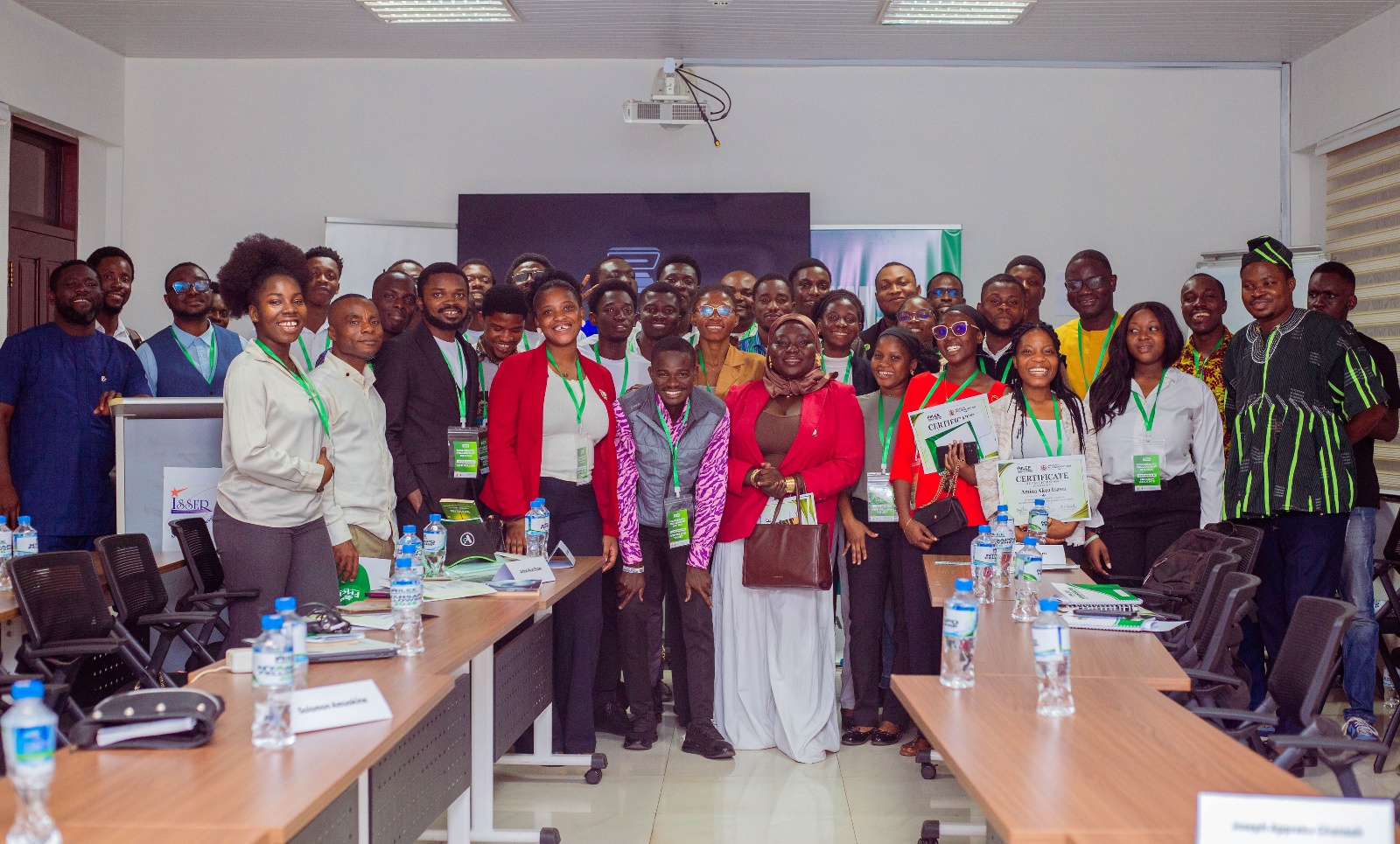
Certificates were presented to all fellows by Dr. Paul Appiah-Konadu and Conrad Kakraba. The closing ceremony included final remarks, a cohort photo session, and announcements. The event concluded at 6:35 PM GMT.
These proceedings concluded the day’s policy presentations, speaker contributions, and review of fellows’ written work.
15. Key Themes Emerging from the Program
The program repeatedly connected liberty with responsibility. Dr. Myles’ philosophical account and Bentil’s keynote both emphasized respect for individuals and the importance of constraining coercive power.
A second theme was the relationship between evidence and persuasion. Kakraba’s advocacy session and policy brief review highlighted the need for well-reasoned proposals and effective communication.
Economic judgment formed another recurring theme. The presentations on financial markets, enterprise finances, and stabilization emphasized the importance of understanding risks, cash flow, costs, and the conditions that shape business decisions.
The event also highlighted the relevance of knowledge to practical problems. Appiah’s education session and the fellows’ policy work focused on applying ideas to real needs.
Bentil’s emphasis on sustained effort provided a central message across these discussions. His keynote encouraged an understanding of reform as continuing work informed by rights, law, and careful consideration of circumstances.
16. Conclusion
The in-person Nyansapo Fellowship 2026 Liberty and Policy Bootcamp brought philosophical ideas into conversation with practical questions of advocacy, enterprise, education, and economic reform. The chapters’ pitches and written policy briefs complemented the speaker sessions by situating fellows’ work within the program.
Kofi Bentil’s keynote offered a central discussion of fundamental rights, the social contract, and modern democracy. His emphasis on equality of opportunity, respect for individual dignity, and consistent effort connected the pursuit of a good society with the responsibilities of individuals and institutions.
The program concluded with recognition of ILEE KNUST’s success in the pitch competition, ILEE UCC’s first-place written policy brief assessment, certificate presentations, and the closing ceremony.