As Israel and the USA wage war on Iran, the news has rightly fixated on Middle Eastern cities. With Iran’s allies striking Gulf ports and Iran threatening the Strait of Hormuz, Emirati weapons flights to Sudan’s RSF rebels have ground to a halt. This unexpected shock has tilted Sudan’s civil war in favor of the government and, for a moment, eased the suffering of civilians. It is a vivid reminder that in our interconnected world, a war in the Persian Gulf can become Africa’s silver lining if we pay attention.
Gulf Turmoil Shuts Down Supply Routes
Last week’s headlines brimmed with reports of drone strikes on UAE airports and Iranian missiles closing the Strait of Hormuz. Some 20% of the world’s oil usually flows through Hormuz, along with countless other goods. Reuters confirms that the U.S.–Israel war on Iran has “convulsed global markets and disrupted supply chains with airspace closures and the halt of shipping through the critical Strait of Hormuz.” The International Energy Agency warned of “the biggest ever oil supply crisis” as Hormuz effectively closed and Gulf producers cut output. Gulf airlines have cancelled tens of thousands of flights, and ports like Dubai’s Jebel Ali, once a hub for African aid, have been struck by intercepted missiles.
In short, the Gulf war has strangled the lifeblood of global trade. Entire Gulf corridors are now off-limits. The UN’s aid chief confirms the impact: “Aid to Gaza and Sudan is grinding to a halt” because relief convoys cannot sail through Hormuz or fly through closed airspace. 25 African countries rely on goods transiting these routes, and many shipments to relief hubs in Djibouti, Nairobi, and Dar es Salaam are stuck. Sudan is in the firing line: UNHCR bluntly warns that “famine-struck Sudan is particularly exposed” by the closing of the Suez Canal, Bab-el-Mandeb and now Hormuz. In this crisis, the same Gulf chokepoints that halted food aid are also effectively blocking arms shipments.
UAE’s RSF Supply Lines Cut
For months, Sudanese generals had warned that the RSF was kept in the fight by a UAE lifeline. The paramilitaries’ rear bases in Darfur were stocked by nocturnal cargo flights and sea deliveries from Emirati ports. The UAE, after all, was long accused, including by Sudan’s own foreign minister of arming the RSF with drones, ammunition and even foreign mercenaries. (Abu Dhabi denies it, of course, but evidence, including satellite imagery, showed numerous cargo planes landing in Chad and Libya for years.) This network has now run into trouble.
With Hormuz closed, flights out of Dubai, Abu Dhabi and Fujairah can no longer reach Africa via the Red Sea. Reuters reports that “airspace closures and sanctions have forced Gulf airlines to cancel thousands of flights,” even hampering routine civilian traffic. Every grounded Emirati cargo jet is a missed shipment of guns or fuel to the RSF. Likewise, with Iran attacking UAE ports, shipping companies have steered clear of the region. The IEA notes that UAE oil exports have been sharply cut by these attacks, and one may be confident that any vessels loaded with MS-20 fuel or RPGs are among those suspended.
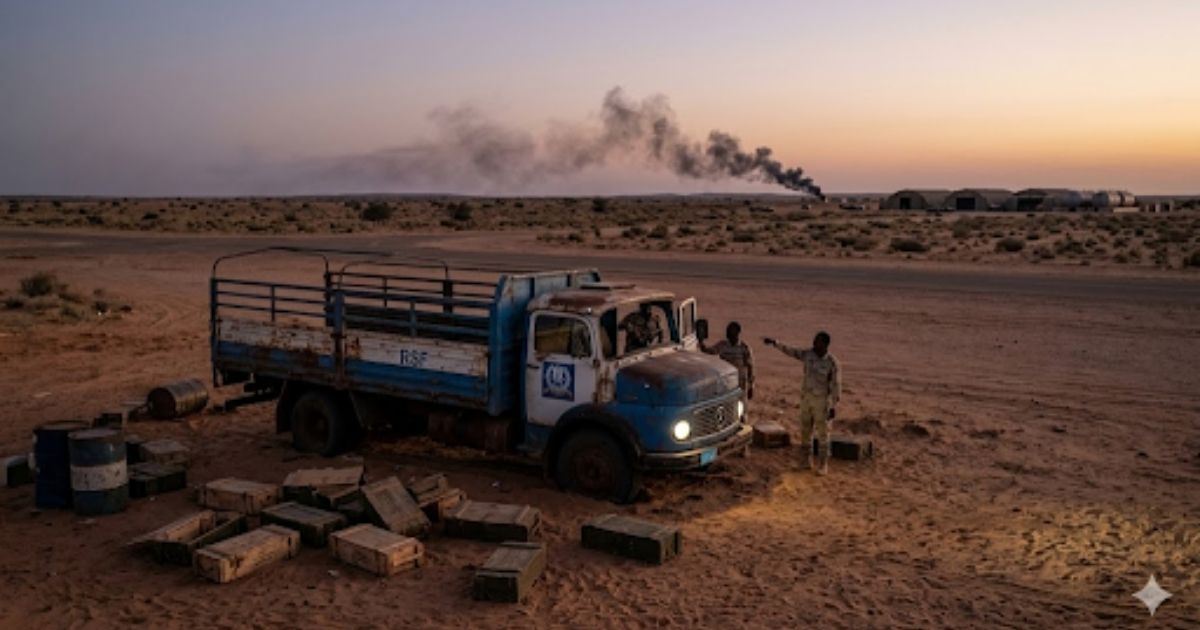
Sudanese insiders say the effect is real. Military sources reported this week that Sudan’s army destroyed two major RSF arms depots near the Chad and Libya borders, seizing vehicles and drones. Even more telling, Al Jazeera reported that in late January the Sudanese army “broke a nearly two-year RSF siege” of Dilling, a key supply hub in South Kordofan. The timing is striking: as Gulf supply routes shut, Sudan’s forces punched through. In official statements, Khartoum attributed this to “heavy losses inflicted on the enemy”, but analysts note that the RSF simply ran low on fuel and ammo, halting their offensives. With motor fuel deliveries from the UAE cut off, many RSF trucks have reportedly idled in the desert. In short, the army is fighting a weaker opponent thanks to the Gulf crisis.
Sudan’s Army Seizes the Moment
This all plays out against Sudan’s own tragedy. Over two years of war, the RSF has laid siege to towns and ethnically cleansed villages in Darfur and Kordofan, causing a humanitarian catastrophe. Any respite for civilians was unimaginable until now. With RSF supply trucks stuck at the Red Sea ports, government garrisons in Darfur and Kordofan have scored hard-earned victories. Tank and helicopter strikes have reclaimed territory that seemed lost, from the outskirts of El-Fasher to the approaches of Kadugli. Villagers who had been trapped by RSF checkpoints suddenly found roads open. Humanitarian agencies quietly report that aid convoys can move slightly more freely into previously besieged camps.
We cannot overstate the importance of this shift. In Dilling, for example, the U.N. had long warned of famine under RSF siege, yet within days of the siege’s end, road markets reopened, and emergency food drops began. Similarly, the government says it has retaken lost supply lines in northern Darfur, which had funneled Khartoum’s own troops. Observers call this the “best chance of relief” for civilians in a generation of war. And it all stems from a global conflict thousands of miles away.
A Wake-Up Call for Africa
Sudan’s story is a wake-up call. It reminds us that no African crisis is an island. When Gulf neighbours reel from war, their far-flung proxies suffer. Yet it also shows Africa’s resilience: conflict bred our leaders’ ingenuity and public pressure, forcing the gulf blockade. Now Africa must own the win. African media and diplomats should connect these dots. African governments must demand guarantees: if foreign powers intervene here, they must face African scrutiny.
This is why we should care. The same air that stopped UAE flights also grounded Sudanese children from attending schools, East African moms from reaching markets, and aid workers from flying in. But for the first time, it is also protecting some innocent lives in Sudan. Whether by fate or design, global chaos is giving the Sudanese a small respite, a chance to rebuild bridges, not barricades.
Global conflicts are entangled. A missile in Tehran can free trapped villagers in Darfur. A drone strike on Fujairah is felt in a North Darfur market. Understanding this web is not cynical geopolitics, it is practical survival. This is why African voices must shout about this nexus.
This war has proved to be intimately connected. The closure of the Strait of Hormuz has echoed into Sudanese valleys. The closure of one war should not become the opening salvo in another. Let our leaders and newsrooms heed this lesson: when distant bombers fall, Sudanese lives can tilt. The fight for Sudan’s peace suddenly has unexpected allies, even if they fly invisible drones high above the Gulf.
About the Author: Haleed Sulemana Namyella is a Human Rights Advocate and Development Professional. He serves as a Research and Policy Associate at the Institute for Liberty and Economic Education (ILEE).
DISCLAIMER: The views and opinions expressed here are not necessarily those of ILEE