
An ancient Adinkra proverb teaches us that “Nyansapo wosane no badwenba”—a wisdom knot is untied only by the wise. The proverb carries a crucial philosophical assumption: social and economic problems are real, complex, and intricate, and those who seek to solve them must possess the freedom to think, experiment, err, and try again.
Today, Africa faces severe economic hurdles, including youth unemployment, fiscal instability, and sluggish productivity. Yet, in our quest for solutions, we too often turn toward state centralization and heavy-handed economic controls, mistaking coercion for direction. A truly prosperous society is built on a fundamentally different principle: human flourishing occurs when individuals are free to exercise their own judgment, hold the fruits of their labor, and exchange voluntarily with one another while taking full responsibility for their choices.
The Moral and Epistemic Case for Liberty
Liberty is not merely an abstract political ideal; it is a moral requirement. Treating competent, adult citizens as unfit to manage their own everyday choices, businesses, and affairs is a fundamental form of disrespect. As thinkers from John Locke and Immanuel Kant to Amartya Sen have argued, human beings are ends in themselves, possess inherent sovereignty over their own lives and labor, and ought not to be reduced to mere instruments of state policy.
Furthermore, Friedrich Hayek demonstrated the profound epistemic limits of central planning. The knowledge required to coordinate a modern economy- local preferences, subtle trade-offs, immediate opportunities, and changing realities—is dispersed among millions of individuals. No ministry, bureaucrat, or centralized council can ever possess this collective intelligence. Dynamic market prices act as the essential communication system that enables strangers to coordinate and cooperate peacefully.
African Institutions and the Myth of Foreign Ideology
Skeptics frequently claim that individual liberty and free markets are alien Western imports incompatible with traditional African values. Historical and philosophical evidence suggests precisely the opposite. Long before colonial distortion and post-independence socialist experiments, indigenous African societies relied heavily on decentralized governance, private property rights, and thriving market networks.
In Akan traditional philosophy, power was intrinsically decentralized through nested stools extending from lineage heads to paramount chiefs. Rulers who abused their mandate were routinely destooled, embodying the principle Ti koro nkɔ agyina—“one head does not go into council.” Economically, traditional systems drew a clear distinction between communal lineage property and self-acquired property earned through individual toil. Ghana’s legendary cocoa industry—which transformed the nation into the world’s leading cocoa exporter by the 1920s—was not built by government master plans, but by independent, migrant indigenous farmers who purchased land, invested their savings, and built market networks from the ground up.
Philosophically, while African thought rightfully emphasizes community, scholars like Kwame Gyekye highlight that individual standing remains paramount. In Akan cosmology, each individual possesses an okra (an innermost soul carrying a personal destiny, nkrabea) and is held accountable for their own moral character. An individual endowed with personal destiny and moral responsibility must possess the political and economic autonomy to fulfill that destiny. Reclaiming economic liberty is not adopting foreign doctrine; it is restoring our own heritage of self-reliance, trade, and voluntary association.
The Limits of State Coercion
Because state intervention relies on ultimate coercion, every regulatory requirement, tax, or price directive carries a heavy burden of justification. We must rigorously evaluate state actions: Is the objective limited to preventing force and fraud? Will the proposed intervention actually achieve its intended goal? Are there less intrusive alternatives?
History offers stark warnings when state power exceeds these boundaries. Ghana’s own experience with severe price controls during the late 1970s and early 1980s illustrates the economic damage of central economic direction. Price ceilings intended to protect consumers instead crippled local production, caused acute shortages, spurred rampant inflation (which peaked over 120%), and bred widespread corruption (kalabule). The primary beneficiaries were not ordinary citizens, but well-connected elites who controlled access to rationed goods. As Frédéric Bastiat observed, the visible effect was a cheap price on paper; the invisible effect was that products vanished from market shelves altogether.
When governments burden enterprise with bureaucratic red tape, complex licensing, and arbitrary regulations, they effectively impose a heavy tax on honesty. Citizens are transformed from dignified rights-holders and entrepreneurs into perpetual petitioners pleading for official favors. The core function of the state must remain focused on protecting property rights, ensuring impartial justice under the rule of law, maintaining public safety, and preserving sound money.
Entrepreneurship and Youth Empowerment
Today, over 36% of Ghana’s population is aged 15 to 35, facing steep youth unemployment challenges. It is a mathematical impossibility for government payrolls to absorb millions of young entrants seeking dignified livelihood. The only viable solution lies in expanding the domain of private enterprise and innovation.
Consider the revolutionary impact of mobile money. Without centralized government planning, millions of young entrepreneurs, agents, and tech innovators built a financial system that processes hundreds of billions of cedis monthly, connecting rural communities and lifting households out of poverty. This is Hayekian coordination in practice: bottom-up problem-solving driven by local knowledge.
To unlock the full potential of our youth, we must embrace five actionable principles:
1. Leverage Local Knowledge: Recognize that local insights and specialized skills are assets no central planner can replicate.
2. Trade Value for Value: Focus on acquiring and offering practical, market-relevant skills that fulfill real human needs.
3. Build Voluntary Institutions: Strengthen civil society, alumni networks, cooperatives, and independent think tanks that foster mutual support and enterprise.
4. Advocate with Evidence: Engage in rigorous, policy-oriented debate to dismantle bureaucratic bottlenecks and champion market-friendly reforms.
5. Demand Limited, Effective Government: Insist that the state focus strictly on its core responsibilities—impartial law enforcement, property rights, sound money, and efficient infrastructure.
Conclusion
Ghana’s national challenges unemployment, fiscal deficits, and low productivity are modern manifestations of the Nyansapo knot. But the wisdom needed to untie this knot does not sit in a single government cabinet or administrative bureau; it is distributed across the minds, talents, and energy of 33 million citizens.
Economic freedom and individual sovereignty are the essential conditions for this dispersed ingenuity to flourish. If we genuinely want sustainable development and true human dignity, we must trust free individuals' creativity, defend open markets, and claim our liberty responsibly.
ABOUT THE AUTHOR
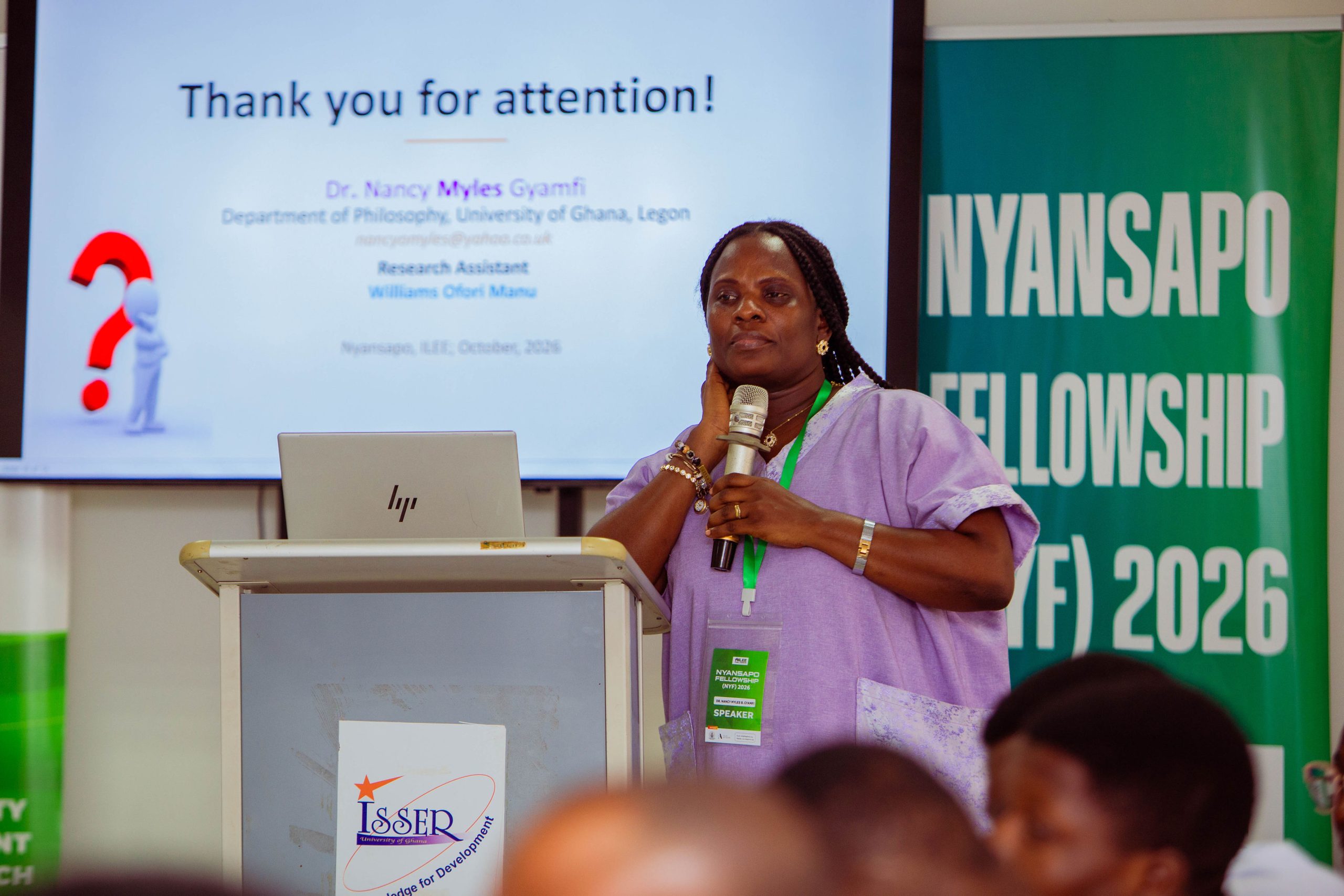
Dr. Nancy Myles B. Gyamfi is a Senior Fellow of the Institute for Liberty and Economic Education (ILEE) and Senior Lecturer in the Department of Philosophy at the University of Ghana.